Spirit Of The East: Thankful To Serve Others
July 25, 2018 | Football
By Joe Corley
ECUPirates.com
ECUPirates.com
Not long after Scottie Montgomery was hired in December 2015 to lead the ECU football program, he got together with Brian Overton to discuss his role with the Pirates.
Overton had come to ECU in January 2012 as director of football operations and player personnel. Montgomery wanted him to stay with the Pirates, but in a different role, one that would have profound importance both within the team and within the community. He was offered the job of director of player development, and he accepted.
Overton, a Hertford County native who has a degree from Elizabeth City State University and also served four years in the U.S. Army and six years as a reservist, got his start in college athletics with three years as an assistant in football operations at North Carolina. The new job under Montgomery, one that previously didn't exist at ECU, has him in charge of things such as life skills training, helping teach budgeting, overseeing volunteer efforts, social media training, consulting with coaches on discipline, and being the program's NFL liaison.
"Coach Montgomery made it very clear that volunteering in the community is very important to him," Overton said. "We had been doing a fairly decent job of that before, but we didn't really have anybody spearheading it. With my transition here, that's one of my objectives.
"We set some goals, and we've broken our community service hours goal record every semester he's been here. We've done more than 200 hours just this summer."
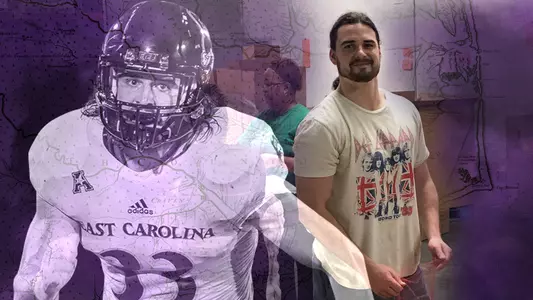
Cannon Gibbs is one of the team leaders in volunteerism. Gibbs, a business management major who is on track to graduate in the spring, embraces the opportunities before him and sets an example for others.
"I'm fortunate to have this platform as an ECU football player, and anytime I can give back is a wonderful opportunity," said Gibbs, a native of Brandon, Miss., who transferred into ECU before his junior year from Jones Junior College in Ellisville, Miss. "Oftentimes when I leave wherever it is that I volunteered, I feel more impacted than those I helped, and it's really remarkable. Especially with my experiences at (James and Connie Maynard Children's Hospital), where last fall I would go on most Thursdays, man, talk about a humbling experience. It really makes you thankful, and it's a good way to give back."
In the last school year, the football team alone accounted for more than 450 hours of volunteer service to the community. Gibbs was one of the leaders, having helped out at the children's hospital, Give Kids a Smile, Aces for Autism Pregame Clinic, Food Bank of Central and Eastern North Carolina, the Special Olympics, Oakmont Church, football camps and the Ladies Football Clinic at ECU.
"All of them have different takeaways," Gibbs said. "Being a part of the Special Olympics was quite the experience. Being able to see those kids and adults go out there and just enjoy it is awesome. It's just inspiring to help them compete at their best level. And there are some very good athletes out there. They get after it."
Overton draws from his military background by splitting the team into four "accountability groups" which compete against each other through a points system. With service, players earn points by completing tasks that he provides, but if it's something set up by the group that they complete on their own, they get double points.
It's important to note that while doing volunteer work is encouraged, there is no requirement.
"And that's the beauty of it," Overton said. "Coach Montgomery and I talked about it when he got here, about how we wanted to do it, and we just think the kids get so much more out of it if it's not something they're forced to do. Obviously it's highly encouraged, and they know we expect that out of them, but it's not something where they have to get X amount of hours. If it were like that, you'd run into a situation where it might become more like a task instead of just giving back. That's not the feeling we want them to have."
Even the coaches are expected to pitch in. Montgomery is particularly involved at Third Street Academy, where he gives each student a new pair of adidas shoes at the beginning of each school year. The football program also spearheads a big back-to-school drive each year in which they and other athletics teams at ECU stuff book bags with school supplies to give to students. Last year, the Pirates gave away more than $2,000 worth of supplies.
Gibbs credits his parents, Mike and Kathy Gibbs, with instilling within him the morals that guide him through life. Those morals helped pave the way for his opportunity to speak to the youth group at Oakmont because he frequently mentioned them in papers he wrote for a business course taught by Sharon Justice.
"She noticed I always mentioned my spiritual life, the reason I'm here, the greater purpose," Gibbs said. "She asked me to speak to the youth group at her church and I was glad to do it. I was fortunate enough to go there and give some words of wisdom from the Good Book, the Bible. It wasn't me, it was God working through me. That was a really special experience for me."
Cannon is the captain of one of the accountability groups, with the other three being Shaun James, Garrett McGhin and Alex Turner. The coaches put the groups together randomly, but the players chose the captains.
Overton uses the groups for things beyond just community service, including academics, on-the-field actions and weight room efficiency, among others.
"Cannon is a big-time leader, and not just for us," Overton said. "He's a natural leader in a classroom setting. He's been fortunate enough to be in some classes where they did some community service as part of a class. He joins our stuff every chance he gets, but he also does it academically."
Gibbs was drawn to ECU partly because ECU sold itself. It's a refrain heard often from decades worth of Pirates.
"As I interacted with people on my visit and made friends, this felt just like home to me," he said. "When I sat down with Coach Mo and talked to him, he just made me feel at home. I trusted him, and I'm all in for ECU. I love it here. I wouldn't trade my decision to commit here for anything."
When his playing days are over, Gibbs wants to stay in football. He likely will search for a graduate assistant job, but above all else, he knows to keep things in their proper order in life.
"Obviously, I don't like to lose — I'm a winner — but there's much more to life than the game of football," he said. "In my eyes, we're here for a very short period of time. Being able to help others definitely helps you with perspective.
"I'm coming up on my senior year, and it's going to be a good one. I'm excited. Fall camp is coming up. We have a lot of athletes, a lot of good players. We just have to go out and do it. The coaches are great. They're giving us everything we need. At the end of the day, the players have to go out and execute, and that's what we plan on doing."
Overton had come to ECU in January 2012 as director of football operations and player personnel. Montgomery wanted him to stay with the Pirates, but in a different role, one that would have profound importance both within the team and within the community. He was offered the job of director of player development, and he accepted.
Overton, a Hertford County native who has a degree from Elizabeth City State University and also served four years in the U.S. Army and six years as a reservist, got his start in college athletics with three years as an assistant in football operations at North Carolina. The new job under Montgomery, one that previously didn't exist at ECU, has him in charge of things such as life skills training, helping teach budgeting, overseeing volunteer efforts, social media training, consulting with coaches on discipline, and being the program's NFL liaison.
"Coach Montgomery made it very clear that volunteering in the community is very important to him," Overton said. "We had been doing a fairly decent job of that before, but we didn't really have anybody spearheading it. With my transition here, that's one of my objectives.
"We set some goals, and we've broken our community service hours goal record every semester he's been here. We've done more than 200 hours just this summer."
Cannon Gibbs is one of the team leaders in volunteerism. Gibbs, a business management major who is on track to graduate in the spring, embraces the opportunities before him and sets an example for others.
"I'm fortunate to have this platform as an ECU football player, and anytime I can give back is a wonderful opportunity," said Gibbs, a native of Brandon, Miss., who transferred into ECU before his junior year from Jones Junior College in Ellisville, Miss. "Oftentimes when I leave wherever it is that I volunteered, I feel more impacted than those I helped, and it's really remarkable. Especially with my experiences at (James and Connie Maynard Children's Hospital), where last fall I would go on most Thursdays, man, talk about a humbling experience. It really makes you thankful, and it's a good way to give back."
In the last school year, the football team alone accounted for more than 450 hours of volunteer service to the community. Gibbs was one of the leaders, having helped out at the children's hospital, Give Kids a Smile, Aces for Autism Pregame Clinic, Food Bank of Central and Eastern North Carolina, the Special Olympics, Oakmont Church, football camps and the Ladies Football Clinic at ECU.
"All of them have different takeaways," Gibbs said. "Being a part of the Special Olympics was quite the experience. Being able to see those kids and adults go out there and just enjoy it is awesome. It's just inspiring to help them compete at their best level. And there are some very good athletes out there. They get after it."
Overton draws from his military background by splitting the team into four "accountability groups" which compete against each other through a points system. With service, players earn points by completing tasks that he provides, but if it's something set up by the group that they complete on their own, they get double points.
It's important to note that while doing volunteer work is encouraged, there is no requirement.
"And that's the beauty of it," Overton said. "Coach Montgomery and I talked about it when he got here, about how we wanted to do it, and we just think the kids get so much more out of it if it's not something they're forced to do. Obviously it's highly encouraged, and they know we expect that out of them, but it's not something where they have to get X amount of hours. If it were like that, you'd run into a situation where it might become more like a task instead of just giving back. That's not the feeling we want them to have."
Even the coaches are expected to pitch in. Montgomery is particularly involved at Third Street Academy, where he gives each student a new pair of adidas shoes at the beginning of each school year. The football program also spearheads a big back-to-school drive each year in which they and other athletics teams at ECU stuff book bags with school supplies to give to students. Last year, the Pirates gave away more than $2,000 worth of supplies.
Gibbs credits his parents, Mike and Kathy Gibbs, with instilling within him the morals that guide him through life. Those morals helped pave the way for his opportunity to speak to the youth group at Oakmont because he frequently mentioned them in papers he wrote for a business course taught by Sharon Justice.
"She noticed I always mentioned my spiritual life, the reason I'm here, the greater purpose," Gibbs said. "She asked me to speak to the youth group at her church and I was glad to do it. I was fortunate enough to go there and give some words of wisdom from the Good Book, the Bible. It wasn't me, it was God working through me. That was a really special experience for me."
Cannon is the captain of one of the accountability groups, with the other three being Shaun James, Garrett McGhin and Alex Turner. The coaches put the groups together randomly, but the players chose the captains.
Overton uses the groups for things beyond just community service, including academics, on-the-field actions and weight room efficiency, among others.
"Cannon is a big-time leader, and not just for us," Overton said. "He's a natural leader in a classroom setting. He's been fortunate enough to be in some classes where they did some community service as part of a class. He joins our stuff every chance he gets, but he also does it academically."
Gibbs was drawn to ECU partly because ECU sold itself. It's a refrain heard often from decades worth of Pirates.
"As I interacted with people on my visit and made friends, this felt just like home to me," he said. "When I sat down with Coach Mo and talked to him, he just made me feel at home. I trusted him, and I'm all in for ECU. I love it here. I wouldn't trade my decision to commit here for anything."
When his playing days are over, Gibbs wants to stay in football. He likely will search for a graduate assistant job, but above all else, he knows to keep things in their proper order in life.
"Obviously, I don't like to lose — I'm a winner — but there's much more to life than the game of football," he said. "In my eyes, we're here for a very short period of time. Being able to help others definitely helps you with perspective.
"I'm coming up on my senior year, and it's going to be a good one. I'm excited. Fall camp is coming up. We have a lot of athletes, a lot of good players. We just have to go out and do it. The coaches are great. They're giving us everything we need. At the end of the day, the players have to go out and execute, and that's what we plan on doing."

Players Mentioned

Linebacker
/ Football
Defensive Tackle
/ Football
Offensive Line
/ Football
Defensive Tackle
/ FootballThursday, September 17
Monday, September 14
Saturday, September 12
Thursday, September 10


