Building The Brand, Managing The Message
August 14, 2018 | Football
ECU took a break from football on Monday afternoon, but not a break from learning.
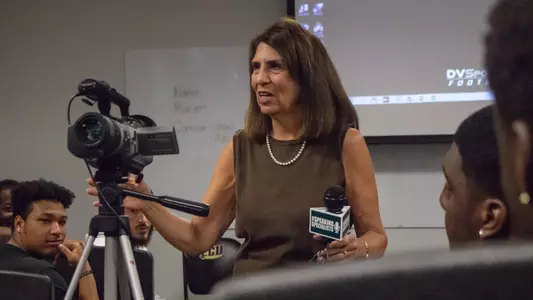
In an interactive and fast-paced one-hour presentation from Sue Castorino of The Speaking Specialists, the players were given tools and tips to use when dealing with the traditional media, as well as things to do and definitely not to do while using social media.
When it comes to social media, there was one unmistakable takeaway: Whether interacting with a fan, a professor or the media, always remember that everything is on record. It's an especially timely lesson in light of recent problems encountered by Milwaukee Brewers pitcher Josh Hader, Atlanta Braves pitcher Sean Newcomb and Washington Nationals shortstop Trea Turner, among others, each of whom received tremendous negative coverage for offensive things they tweeted when they were teenagers.
"Everything they do will be seen by everyone, and it's all out there and it's all for the public," Castorino said. "If they don't have the good reputation now they need to get the good reputation now because it's going to be with them forever. The most important thing for them, I know now they're focused on football and college, but every single one of them will have to get a job out there in the real world eventually. I want them to be aware that this stuff will be with them. You can't just say, 'I deleted it,' because within a nanosecond, it's out there and it's out there forever."
Castorino and her husband, Randy Minkoff, founded The Speaking Specialists, based in Chicago, in 1986. Castorino, a 1975 graduate of Northwestern with a degree in speech, had been a reporter on television stations in Chicago and Cleveland. Newly married and not seeing her husband, who also was in journalism, much spurred her to get out of that business and into media training.
"I had been doing what I did for so long, and it was just really time to move on," she said. "I really wanted to help people. It's a lot like social work because I had done so many interviews and covered so many speeches that weren't good, and I thought, I have something to offer here to make them better, because ultimately that makes my job easier."
The company's first clients were U.S. Olympians, but now they're busy with college sports programs as well as teams in all the professional sports. Before coming to ECU, Castorino's last stop was in Cincinnati to work with the Bengals.
Frequently, she stopped during her presentation and called out players for individual mock interviews in front of the full team meeting room. She told them how to stand when in front of a camera, to give a firm handshake, address the interviewer by name and make eye contact. She also discussed things to say and things not to say with the players and urged them to talk about their own team and no others.
"There's no reason to talk about the past," Castorino said. "The past is done, no matter how bad or even how good last year was, it's done. Even if you won that national title last year, it's done."
Deondre Farrier was the first one called for a mock interview, and Alex Turner, Reid Herring, Colby Gore, Peyton Winstead and Raequan Purvis followed him at various points of the presentation.
"I want them to have confidence every time they speak, and I want them to know that it's all public communication," Castorino said. "They are judged to a higher standard because of their stature here at ECU. I want them to make ECU proud on the field and off the field."
Players were warned about overusing catch phrases, and the problems with using the phrases "No comment" and "I was just kidding." To add a little levity, Castorino showed the scene from the movie "Talladega Nights" in which Ricky Bobby was interviewed on television for the first time.
Then, interviews from various players from their high school days were shown, driving home that point that, as Castorino said, "All your interviews are part of your resume."
Used properly, social media can be a positive tool. Unfortunately, social media also can come back to haunt, and over time that has become a part of Castorino's lessons.
"I remember when Twitter first started and I was working with an elite group from USA Track and Field, and Kanye West, that was when he was big on it," she said. "I told them all, 'Pay attention to this. It's really going to take off. Kanye's on it.' And they all just glazed over because they didn't know what it was.
"The next year when I came back, it had exploded. So now, it's half the presentation. But most of them now, they know, they know how to do it, certainly. I think they're understanding the ramifications more and more because they see what people are doing out in public. But they just need to know what they need to know."
Another change over time has been the way traditional media approach athletes and coaches. Gone are the days when everything was all about what happened on the field of competition.
"It isn't just sports questions-driven anymore," Castorino said. "I started to realize that five or six years ago. They are looking for more of this personality stuff because they, too, are on social media. So players need to be aware that they're going to be asked maybe about what's going on in the world and what their view of it is."
One of the lightest moments of the presentation was when Castorino displayed social media posts on the big screen and asked if the players could tell which of their teammates the post belonged to. One of the posts that drew the loudest reaction was a photo of John Spellacy waterskiing when he was about 12.
"I wanted them to have some fun," Castorino said. "It has to be fun and engaged learning or they won't pay attention."
- Joe Corley
In an interactive and fast-paced one-hour presentation from Sue Castorino of The Speaking Specialists, the players were given tools and tips to use when dealing with the traditional media, as well as things to do and definitely not to do while using social media.
When it comes to social media, there was one unmistakable takeaway: Whether interacting with a fan, a professor or the media, always remember that everything is on record. It's an especially timely lesson in light of recent problems encountered by Milwaukee Brewers pitcher Josh Hader, Atlanta Braves pitcher Sean Newcomb and Washington Nationals shortstop Trea Turner, among others, each of whom received tremendous negative coverage for offensive things they tweeted when they were teenagers.
"Everything they do will be seen by everyone, and it's all out there and it's all for the public," Castorino said. "If they don't have the good reputation now they need to get the good reputation now because it's going to be with them forever. The most important thing for them, I know now they're focused on football and college, but every single one of them will have to get a job out there in the real world eventually. I want them to be aware that this stuff will be with them. You can't just say, 'I deleted it,' because within a nanosecond, it's out there and it's out there forever."
Castorino and her husband, Randy Minkoff, founded The Speaking Specialists, based in Chicago, in 1986. Castorino, a 1975 graduate of Northwestern with a degree in speech, had been a reporter on television stations in Chicago and Cleveland. Newly married and not seeing her husband, who also was in journalism, much spurred her to get out of that business and into media training.
"I had been doing what I did for so long, and it was just really time to move on," she said. "I really wanted to help people. It's a lot like social work because I had done so many interviews and covered so many speeches that weren't good, and I thought, I have something to offer here to make them better, because ultimately that makes my job easier."
The company's first clients were U.S. Olympians, but now they're busy with college sports programs as well as teams in all the professional sports. Before coming to ECU, Castorino's last stop was in Cincinnati to work with the Bengals.
Frequently, she stopped during her presentation and called out players for individual mock interviews in front of the full team meeting room. She told them how to stand when in front of a camera, to give a firm handshake, address the interviewer by name and make eye contact. She also discussed things to say and things not to say with the players and urged them to talk about their own team and no others.
"There's no reason to talk about the past," Castorino said. "The past is done, no matter how bad or even how good last year was, it's done. Even if you won that national title last year, it's done."
Deondre Farrier was the first one called for a mock interview, and Alex Turner, Reid Herring, Colby Gore, Peyton Winstead and Raequan Purvis followed him at various points of the presentation.
"I want them to have confidence every time they speak, and I want them to know that it's all public communication," Castorino said. "They are judged to a higher standard because of their stature here at ECU. I want them to make ECU proud on the field and off the field."
Players were warned about overusing catch phrases, and the problems with using the phrases "No comment" and "I was just kidding." To add a little levity, Castorino showed the scene from the movie "Talladega Nights" in which Ricky Bobby was interviewed on television for the first time.
Then, interviews from various players from their high school days were shown, driving home that point that, as Castorino said, "All your interviews are part of your resume."
Used properly, social media can be a positive tool. Unfortunately, social media also can come back to haunt, and over time that has become a part of Castorino's lessons.
"I remember when Twitter first started and I was working with an elite group from USA Track and Field, and Kanye West, that was when he was big on it," she said. "I told them all, 'Pay attention to this. It's really going to take off. Kanye's on it.' And they all just glazed over because they didn't know what it was.
"The next year when I came back, it had exploded. So now, it's half the presentation. But most of them now, they know, they know how to do it, certainly. I think they're understanding the ramifications more and more because they see what people are doing out in public. But they just need to know what they need to know."
Another change over time has been the way traditional media approach athletes and coaches. Gone are the days when everything was all about what happened on the field of competition.
"It isn't just sports questions-driven anymore," Castorino said. "I started to realize that five or six years ago. They are looking for more of this personality stuff because they, too, are on social media. So players need to be aware that they're going to be asked maybe about what's going on in the world and what their view of it is."
One of the lightest moments of the presentation was when Castorino displayed social media posts on the big screen and asked if the players could tell which of their teammates the post belonged to. One of the posts that drew the loudest reaction was a photo of John Spellacy waterskiing when he was about 12.
"I wanted them to have some fun," Castorino said. "It has to be fun and engaged learning or they won't pay attention."
- Joe Corley


Players Mentioned
Wide Receiver
/ Football
Defensive Back
/ Football
Quarterback
/ Football
Defensive Tackle
/ Football
Offensive Line
/ Football
Defensive Tackle
/ Football
Offensive Line
/ FootballThursday, September 17
Monday, September 14
Saturday, September 12
Thursday, September 10


