“Collegiate Battlefield” Ties Military Training, College Football
October 16, 2018 | General
The words practically jumped right off the page at Jeff Connors, so much so that he can summon them from memory instantly and with ease.
"Human nature is subject to the complexities, inconsistencies and peculiarities which characterize human behavior."
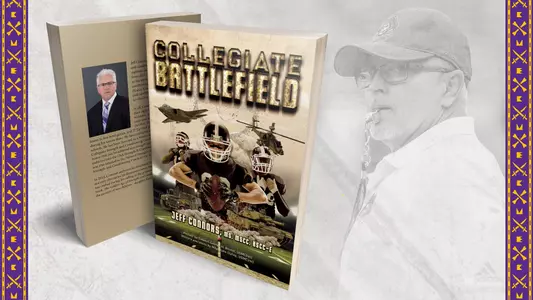
Connors, who is ECU's Assistant Athletics Director for Strength and Conditioning, was reading the Marine Corps War Fighting Skills Manual when he came across that passage. It became the genesis for his second book, Collegiate Battlefield, which is available now. Following up five years later on his first book, Strength Coach: A Call to Serve, Connors said this book was written to investigate the application and relevance of military training principles to collegiate football.
"That hit me right in the face," he said. "I said, wait a second, this is exactly what I deal with every single day. And I knew I had to get this out there, I've got to write about it. I've got to develop some ideas where this is concerned, and I've got to let people know what we deal with in regard to athletes year in and year out."
Connors began his affiliation with ECU in 1991 and worked here until 2001, when he took a job at UNC before eventually returning to ECU in 2011. After turning down an offer to be lead strength trainer for special ops Marines (MARSOC) to stay at UNC, he said he came to the realization that working with collegiate athletes was his calling. He wanted to try to influence young people as much as he could, even though he already was experiencing some frustration with what he called "the discipline aspect and how each program through the years suffers with attrition because of lack of discipline."
The book details part of how he deals with that, by using methods employed by the military. He saw, for example, how it worked first-hand when his son, Beau, graduated boot camp.
"I have a total respect for the United States military organizations and what they do and how they train," Connors said.
Connors brings Marines in often to speak with the ECU football team about one of the 14 USMC leadership traits: justice, judgment, dependability, initiative, decisiveness, tact, integrity, endurance, bearing, unselfishness, courage, knowledge, loyalty and enthusiasm.
The speakers also give examples of uncommon valor that they have experienced themselves so the athletes can understand the importance of core values and the team concept along with mental and physical toughness.
"I think we as a society are suffering and becoming deficient in those areas," Connors said. "There are many things people blame for that such as millennials and the Y and Z generation, entitlement, not wanting to pay the price, not being able to focus deeply on anything because of social media. I don't know how true those things are, I just know that people talk about them a lot. And if in fact they're true, then we have to find some way to begin to correct the issues.
"I'm standing on my soapbox in this book and talking about how something needs to be done in relationship to the educational process to make sure we're doing everything we can to keep players in the program."
With that in mind, the focused chapters of his book are Trust; Mental and Physical Toughness; Loyalty and Ferocity; How to Develop Self-Discipline; The Unique Essence of Leadership on the Gridiron; and Esprit de Corps. Then, after considering all those things, he closes with What's the Plan?
An overriding theme that comes up often is what the Marines refer to as the "chief incalculable," or the human will. Each chapter ends with a military anecdote written by Master Sgt. John Dailey, USMC (retired).
"He did a tremendous job of that, an incredible job," Connors said. "These short stories in this book are extremely powerful."
Col. George H. Bristol, USMC (retired), who designed the martial arts system used by the Marine Corps, wrote the preface. Bristol spoke to the Pirates before their win over BYU last season.
"Being affiliated with those guys, along with retired Maj. Jamie Farrelly down at Lejeune, has been extremely important to me," Connors said. "I believe the more we can incorporate what these military organizations stand for with our athletes, the more we can deeply investigate those things, the better chance we're going to have of making them better athletes and better people."
Although the book title ties directly to collegiate athletics, Connors believes the lessons within can be utilized in everyday life.
"Those four things that I hang my hat on — accountability, work ethic, discipline and spirit — I tell my guys that no matter what job you get or what you do with your life, you're going to have to be excited every day about what you do," he said. "You have to have discipline, you have to show up everyday, on time, and work hard, or you're not going to have a job."
The walls of his office are covered with pictures of players whom Connors respects not because of how good a football player they are, but for what they've accomplished in relationship to what they were perceived to be, how they overachieved and succeeded beyond that. They are players such as Dwayne Ledford, Marcus Crandell, Jeff Blake, Kevin Monroe, Scott Harley, George Koonce and Morris Foreman, just to name a few.
"Not all of them made it to the NFL," Connors said. "I have Scott Harley up there, for example, because the whole stadium used to chant his name. Morris Foreman passed away, but I honor him every year. I have tremendous respect for these people. I've tried to be that type of example myself. I've tried to achieve things at the highest level of my profession. My main motivation for anything that I've achieved is to be a great model for the people that I coach."
-Joe Corley
"Human nature is subject to the complexities, inconsistencies and peculiarities which characterize human behavior."
Connors, who is ECU's Assistant Athletics Director for Strength and Conditioning, was reading the Marine Corps War Fighting Skills Manual when he came across that passage. It became the genesis for his second book, Collegiate Battlefield, which is available now. Following up five years later on his first book, Strength Coach: A Call to Serve, Connors said this book was written to investigate the application and relevance of military training principles to collegiate football.
"That hit me right in the face," he said. "I said, wait a second, this is exactly what I deal with every single day. And I knew I had to get this out there, I've got to write about it. I've got to develop some ideas where this is concerned, and I've got to let people know what we deal with in regard to athletes year in and year out."
Connors began his affiliation with ECU in 1991 and worked here until 2001, when he took a job at UNC before eventually returning to ECU in 2011. After turning down an offer to be lead strength trainer for special ops Marines (MARSOC) to stay at UNC, he said he came to the realization that working with collegiate athletes was his calling. He wanted to try to influence young people as much as he could, even though he already was experiencing some frustration with what he called "the discipline aspect and how each program through the years suffers with attrition because of lack of discipline."
The book details part of how he deals with that, by using methods employed by the military. He saw, for example, how it worked first-hand when his son, Beau, graduated boot camp.
"I have a total respect for the United States military organizations and what they do and how they train," Connors said.
Connors brings Marines in often to speak with the ECU football team about one of the 14 USMC leadership traits: justice, judgment, dependability, initiative, decisiveness, tact, integrity, endurance, bearing, unselfishness, courage, knowledge, loyalty and enthusiasm.
The speakers also give examples of uncommon valor that they have experienced themselves so the athletes can understand the importance of core values and the team concept along with mental and physical toughness.
"I think we as a society are suffering and becoming deficient in those areas," Connors said. "There are many things people blame for that such as millennials and the Y and Z generation, entitlement, not wanting to pay the price, not being able to focus deeply on anything because of social media. I don't know how true those things are, I just know that people talk about them a lot. And if in fact they're true, then we have to find some way to begin to correct the issues.
"I'm standing on my soapbox in this book and talking about how something needs to be done in relationship to the educational process to make sure we're doing everything we can to keep players in the program."
With that in mind, the focused chapters of his book are Trust; Mental and Physical Toughness; Loyalty and Ferocity; How to Develop Self-Discipline; The Unique Essence of Leadership on the Gridiron; and Esprit de Corps. Then, after considering all those things, he closes with What's the Plan?
An overriding theme that comes up often is what the Marines refer to as the "chief incalculable," or the human will. Each chapter ends with a military anecdote written by Master Sgt. John Dailey, USMC (retired).
"He did a tremendous job of that, an incredible job," Connors said. "These short stories in this book are extremely powerful."
Col. George H. Bristol, USMC (retired), who designed the martial arts system used by the Marine Corps, wrote the preface. Bristol spoke to the Pirates before their win over BYU last season.
"Being affiliated with those guys, along with retired Maj. Jamie Farrelly down at Lejeune, has been extremely important to me," Connors said. "I believe the more we can incorporate what these military organizations stand for with our athletes, the more we can deeply investigate those things, the better chance we're going to have of making them better athletes and better people."
Although the book title ties directly to collegiate athletics, Connors believes the lessons within can be utilized in everyday life.
"Those four things that I hang my hat on — accountability, work ethic, discipline and spirit — I tell my guys that no matter what job you get or what you do with your life, you're going to have to be excited every day about what you do," he said. "You have to have discipline, you have to show up everyday, on time, and work hard, or you're not going to have a job."
The walls of his office are covered with pictures of players whom Connors respects not because of how good a football player they are, but for what they've accomplished in relationship to what they were perceived to be, how they overachieved and succeeded beyond that. They are players such as Dwayne Ledford, Marcus Crandell, Jeff Blake, Kevin Monroe, Scott Harley, George Koonce and Morris Foreman, just to name a few.
"Not all of them made it to the NFL," Connors said. "I have Scott Harley up there, for example, because the whole stadium used to chant his name. Morris Foreman passed away, but I honor him every year. I have tremendous respect for these people. I've tried to be that type of example myself. I've tried to achieve things at the highest level of my profession. My main motivation for anything that I've achieved is to be a great model for the people that I coach."
-Joe Corley



Thursday, September 17
Monday, September 14
Saturday, September 12
Thursday, September 10


