Adjusting to the Speed of Play at East Carolina
August 10, 2017 | Soccer
By Joe Corley
ECUPirates.com
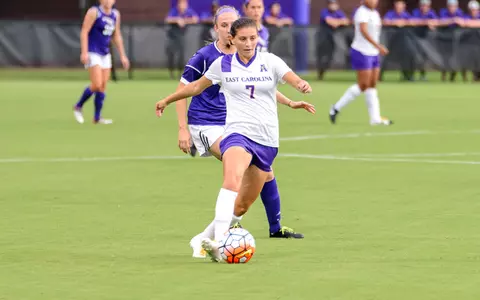
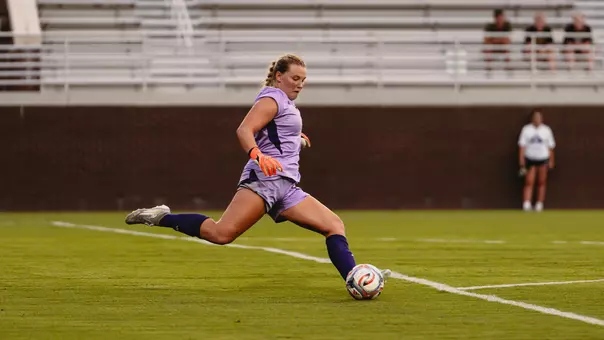
Players who are able to make the transition from high school and club soccer to the college level typically are the players who are a step or two ahead in seeing the play unfold before them. Mentally and then physically, they've made the move before the opponent could figure out what was coming.
But when they show up at camp for their freshman season in college, more often than not they quickly learn that the strength they had in high school and club has either been minimized or negated by older, quicker competition. It's a constant concern and point of emphasis for East Carolina women's soccer coach Rob Donnenwirth.
"We call is speed of play, which is speed of thought, how quickly you can pull off the technique," said Donnenwirth, whose team will open its season in Johnson Stadium at 7 p.m. Friday, Aug. 18 against Dayton. "It may look easy when you're sitting up high watching, but when you're at field level, it looks a lot different."
Midfielder Jenna Geist, a fifth-year senior who is a captain this season, knows that well. Before coming to ECU, she played for one of the top club teams in Colorado. She compared some of her early experiences with the Pirates to being in a race.
"I felt like I was just running back and forth," she said. "I'd get up there, the ball would be there, then I'd look back and just be running again. Basically, what I got used to is you really have to be prepared for the change in direction, the fast pace. Be prepared each game to battle. I don't think I was used to that. I was used to just going out on the field and playing soccer. Each game here is a way bigger deal and way more fast-paced."
Geist said it took her about half a season to adjust. But she clearly remembers how daunting the adjustment period was.
"Preseason, I was just kind of in shock," she said. "It's hard to say how it happens and when it happens, but the game just sort of slows down for them at some point," Donnenwirth said "And there are certain positions that are harder. As a center-midfielder, you're dealing with 360 degrees around you when you're receiving the ball. You don't know where the pressure's coming from. If you're a wide player, you probably only have to deal with 180 degrees.
"You talk about giving support for a player that's receiving the ball, it might be just dropping two yards more than staying one yard where, when you're a receiver, you have less time to make a decision than if you were two yards back. That might make the difference. We talk about the little details even when we're working on something technically, how we check off players and do all those things."
As an older player, Geist now is in a good position to help out the newcomers. Two of the freshmen this season are defender Kim Sanford and midfielder/forward Cashlin Copley, who were teammates on a club team in Pennsylvania.
"We were around a lot of national team players, high-level players in club," Sanford said. "But here, even in practice, it's just different. Everything is done with such intensity. Not that our club team wasn't intense, but this is a different level. Everyone here is more aggressive, and everything is quicker and sharper."
"It's much more aggressive," Copley said. "It's quicker, but I feel like our club prepared us for that. But things are more aggressive out of the air."
They got an introduction to the college speed of play during a scrimmage against Virginia Commonwealth on Aug. 8. Things were a little tough early.
"The way we play defensively, everybody on the field has to be doing the right thing," Donnenwirth said. "If one piece is missing, it's going to be very difficult. If someone's pressuring the ball, you need someone getting there quickly to cover. You need someone balancing and dealing with the ball being split between those two. If the split player isn't there, those two did a lot of work for nothing. And that was happening at the beginning of the (scrimmage against VCU)."
During times like that, it helps to have a short memory.
"When I came in as a freshman, I felt like if I made a mistake, it was a big deal and terrible," Geist said. "Now that I'm older and have learned, I know mistakes are going to happen, and you just have to react and adjust correctly to them."
"Positive reinforcement," Copley said. "It's all positive here."
And for Sanford and Copley, it's also comforting to be able to see a familiar face.
"We're going through the same thing, and we're going through it together," Sanford said. "Sometimes I'm like, 'Cash, I don't know what I'm doing.' And she says, 'It's fine, I don't know what I'm doing, too.' It's cool that we can be there for each other."
ECUPirates.com
Players who are able to make the transition from high school and club soccer to the college level typically are the players who are a step or two ahead in seeing the play unfold before them. Mentally and then physically, they've made the move before the opponent could figure out what was coming.
But when they show up at camp for their freshman season in college, more often than not they quickly learn that the strength they had in high school and club has either been minimized or negated by older, quicker competition. It's a constant concern and point of emphasis for East Carolina women's soccer coach Rob Donnenwirth.
"We call is speed of play, which is speed of thought, how quickly you can pull off the technique," said Donnenwirth, whose team will open its season in Johnson Stadium at 7 p.m. Friday, Aug. 18 against Dayton. "It may look easy when you're sitting up high watching, but when you're at field level, it looks a lot different."
Midfielder Jenna Geist, a fifth-year senior who is a captain this season, knows that well. Before coming to ECU, she played for one of the top club teams in Colorado. She compared some of her early experiences with the Pirates to being in a race.
"I felt like I was just running back and forth," she said. "I'd get up there, the ball would be there, then I'd look back and just be running again. Basically, what I got used to is you really have to be prepared for the change in direction, the fast pace. Be prepared each game to battle. I don't think I was used to that. I was used to just going out on the field and playing soccer. Each game here is a way bigger deal and way more fast-paced."
Geist said it took her about half a season to adjust. But she clearly remembers how daunting the adjustment period was.
"Preseason, I was just kind of in shock," she said. "It's hard to say how it happens and when it happens, but the game just sort of slows down for them at some point," Donnenwirth said "And there are certain positions that are harder. As a center-midfielder, you're dealing with 360 degrees around you when you're receiving the ball. You don't know where the pressure's coming from. If you're a wide player, you probably only have to deal with 180 degrees.
"You talk about giving support for a player that's receiving the ball, it might be just dropping two yards more than staying one yard where, when you're a receiver, you have less time to make a decision than if you were two yards back. That might make the difference. We talk about the little details even when we're working on something technically, how we check off players and do all those things."
As an older player, Geist now is in a good position to help out the newcomers. Two of the freshmen this season are defender Kim Sanford and midfielder/forward Cashlin Copley, who were teammates on a club team in Pennsylvania.
"We were around a lot of national team players, high-level players in club," Sanford said. "But here, even in practice, it's just different. Everything is done with such intensity. Not that our club team wasn't intense, but this is a different level. Everyone here is more aggressive, and everything is quicker and sharper."
"It's much more aggressive," Copley said. "It's quicker, but I feel like our club prepared us for that. But things are more aggressive out of the air."
They got an introduction to the college speed of play during a scrimmage against Virginia Commonwealth on Aug. 8. Things were a little tough early.
"The way we play defensively, everybody on the field has to be doing the right thing," Donnenwirth said. "If one piece is missing, it's going to be very difficult. If someone's pressuring the ball, you need someone getting there quickly to cover. You need someone balancing and dealing with the ball being split between those two. If the split player isn't there, those two did a lot of work for nothing. And that was happening at the beginning of the (scrimmage against VCU)."
During times like that, it helps to have a short memory.
"When I came in as a freshman, I felt like if I made a mistake, it was a big deal and terrible," Geist said. "Now that I'm older and have learned, I know mistakes are going to happen, and you just have to react and adjust correctly to them."
"Positive reinforcement," Copley said. "It's all positive here."
And for Sanford and Copley, it's also comforting to be able to see a familiar face.
"We're going through the same thing, and we're going through it together," Sanford said. "Sometimes I'm like, 'Cash, I don't know what I'm doing.' And she says, 'It's fine, I don't know what I'm doing, too.' It's cool that we can be there for each other."
Players Mentioned


Monday, November 11
Friday, September 23
Friday, September 16
Monday, September 12


